
Roddie Edmonds
The order had come the night before, announced over the loudspeaker: in the morning, all Jewish prisoners were to report for roll call. Everyone else was to stay inside.
Master Sergeant Roddie Edmonds was the senior American non-commissioned officer at Stalag IX-A, a German POW camp near Ziegenhain. He had arrived two days earlier with more than 1,200 fellow soldiers, most of them captured during the chaos of the Battle of the Bulge. As the ranking NCO, the men were his responsibility. That night, he gave them an order of his own: everyone falls out in the morning. Every last man.
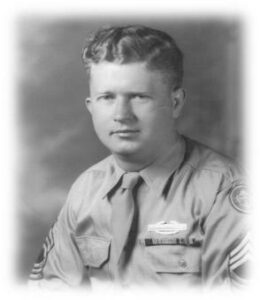
When the German commandant arrived at roll call and saw the entire American population of the camp standing in formation, he was furious. He called Edmonds forward and demanded that only the Jewish soldiers present themselves. Edmonds refused. The commandant pressed his pistol against Edmonds’ forehead.
Edmonds didn’t move.
He told the commandant that the Geneva Convention required a prisoner to provide only name, rank, and serial number — not religion. And then he said: “We are all Jews here.” If the commandant wanted to shoot him, he added, he would have to shoot all of them. The war was nearly over. Edmonds knew it, and the commandant knew it too. War criminals were going to be prosecuted. The commandant lowered his pistol and walked back to his office.
Roughly 200 Jewish-American soldiers went back to their barracks that morning.
Edmonds had watched what happened at the previous camp, Stalag IX-B, where the Nazis had already separated Jewish soldiers into segregated barracks, cut their rations, and ultimately sent hundreds east to a forced labor camp called Berga. Some of them died there. He understood what “report separately” meant. When the order came at Stalag IX-A, he didn’t deliberate. He couldn’t stop the war. He couldn’t liberate the camp. What he could do was refuse to be the one who handed them over — refuse to make it easy, refuse to be complicit in whatever came next.
He came home after the war and didn’t speak of it. Not to friends, not to his family. His sons knew only that he had fought in the Battle of the Bulge and come home. He worked in sales, in journalism, remarried, lived a quiet life in Knoxville. He died in 1985, unrecognized, having told no one what he’d done.
It was a fellow prisoner, Lester Tanner, who finally told Edmonds’ son Chris the story — in 2013, nearly thirty years after Roddie’s death. Tanner had been there that morning. He remembered everything.
Roddie Edmonds was recognized by Yad Vashem as Righteous Among the Nations in 2015 — the only American soldier ever to receive that honor. He was awarded the Medal of Honor, posthumously, in March of this year.
He didn’t save those men because he thought history was watching. He saved them because they were his men, the commandant was pointing at them, and he wasn’t going to be the one who stepped aside.